VelOT Documentation





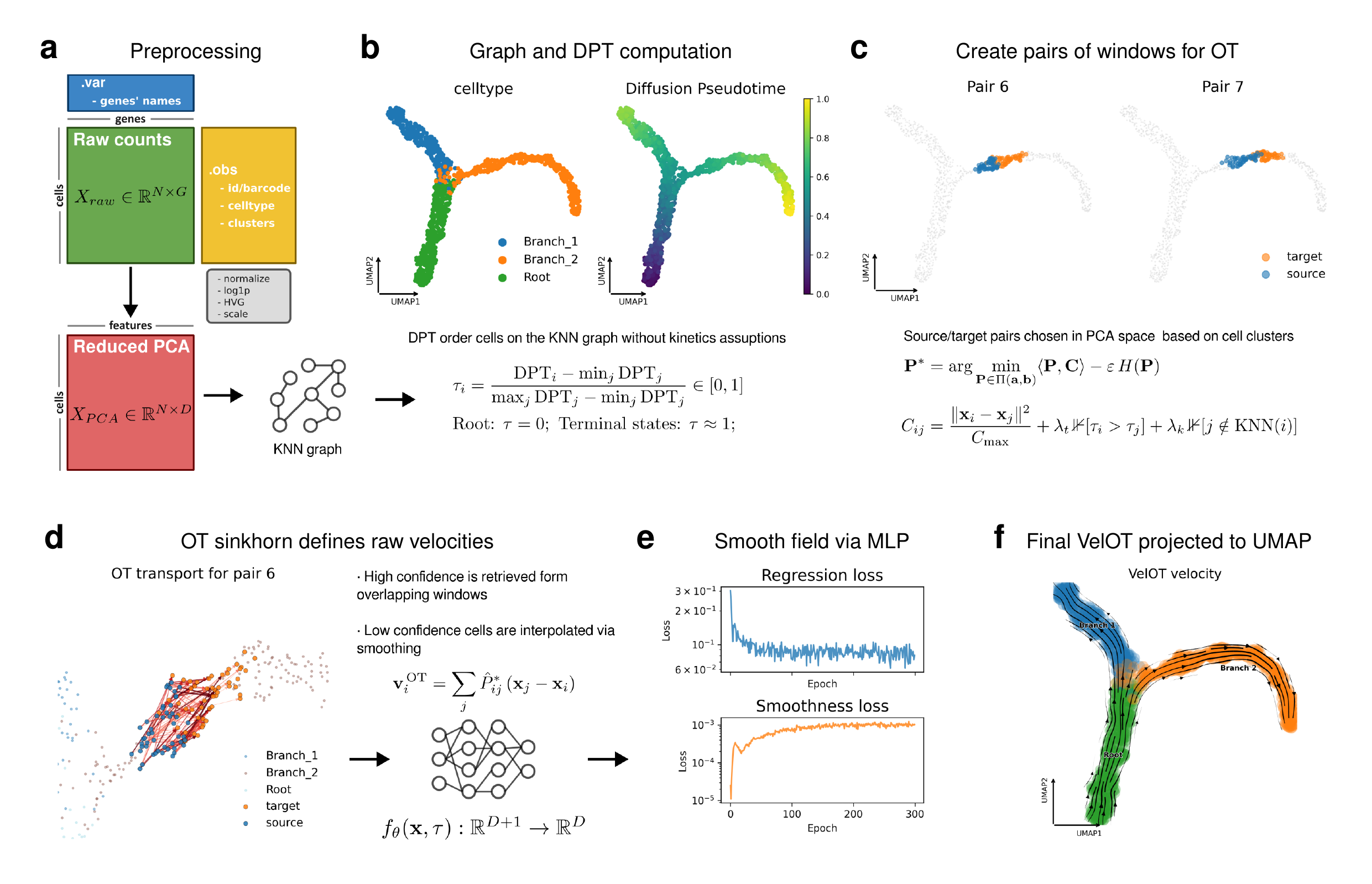
VelOT (Velocity via Optimal Transport) is a kinetic-free framework for estimating RNA velocity from single-cell transcriptomic data.
Why VelOT?
Existing RNA velocity methods (velocyto, scVelo) rely on modeling the molecular kinetics of splicing and degradation, requiring spliced/unspliced count matrices and assumptions about transcriptional steady states that frequently fail in complex biological systems.
VelOT takes a fundamentally different approach. It treats velocity inference as an optimal transport problem in gene expression space:
Kinetic-free: no spliced/unspliced counts needed — works with any gene expression matrix.
Principled directionality: pseudotime-informed cost matrices enforce biologically consistent forward transport.
Continuous velocity fields: a neural network smoothing step produces a velocity function that can be evaluated at any point in expression space, not just at observed cell positions.
Robust evaluation: built-in metrics (ICCoh, CBDir) and a benchmarking framework for systematic velocity quality assessment.
Key Features
🔬 Preprocessing |
Automated pipeline with pseudotime via Diffusion Pseudotime |
🪟 Spatial-temporal windowing |
Two-level strategy ensuring local, biologically meaningful OT |
🚚 Optimal transport velocity |
Structured cost matrices with pseudotime and KNN penalties |
🧠 Neural smoothing |
MLP-based continuous velocity field with confidence weighting |
📊 Visualization |
Stream plots, trajectory analysis, metric dashboards |
📏 Evaluation |
ICCoh, CBDir metrics with built-in benchmarking |
Quick Example
import velot

adata = velot.datasets.pancreas()
adata = velot.pp.prepare(adata, root_cluster="Ductal", cluster_key="clusters")
velot.tl.velocity(adata)
velot.pl.velocity_stream(adata, color="clusters")
Getting Started
Tutorials
User Guide
API Reference
About
If you use VelOT in your research, please cite:
@article {velot2026,
   author = {Rincon de la Rosa, Lucas and Perez Garcia, David and Alentorn, Agusti},
   title = {VelOT: kinetic-free RNA velocity inference via optimal transport, flow-field smoothing, and VAMP coarse-graining of cellular dynamics},
   elocation-id = {2026.06.04.730132},
   year = {2026},
   doi = {10.64898/2026.06.04.730132},
   publisher = {Cold Spring Harbor Laboratory},
   URL = {https://www.biorxiv.org/content/early/2026/06/06/2026.06.04.730132},
   eprint = {https://www.biorxiv.org/content/early/2026/06/06/2026.06.04.730132.full.pdf},
   journal = {bioRxiv}
   }